Soliloquy
Soliloquy is a movement practice developed by Monika Błaszczak at the intersection of choreography and hauntology. In Soliloquy, dancers approach their bodies as archives of past, present, and future experiences, and explore their relationship with other bodies, including more-than-human bodies.
Soliloquy uses hauntology as a framework for studying the body in its memory and its becoming. The term was coined by Jacques Derrida in “Spectres of Marx: The State of the Debt, the Work of Mourning and the New International” (1993). Derrida’s play on the words “haunted” and “ontology” complicates the classical understanding of time. Grounded in this perspective, Soliloquy is based on the belief that bodies are always-already haunted by personal, collective, and intergenerational histories and desires.
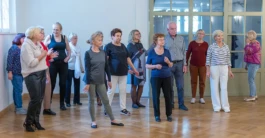
The practice consists of choreographic scores that can be enacted solo or in a group. No prior experience is necessary. The scores invite dancers to explore embodied memory, imagination, and relationality, and to attend to the emotions present in the moment. Through this dance practice, participants metabolize life experience and compose their becoming.
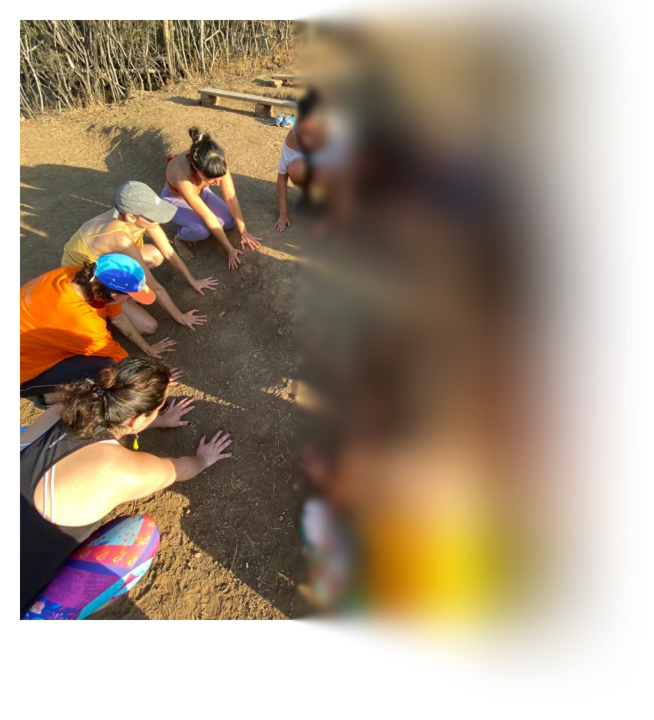
For example, one score invites participants to create a movement gift for a chosen person or entity, for instance the participants’ grandmothers. One by one, dancers step into the center of a circle and offer their movement while others witness, holding space for the gift to be received. The group then echoes and amplifies the gesture, allowing it to resonate collectively before the next person enters. The practice closes with a shared improvisation woven from the traces that have appeared.
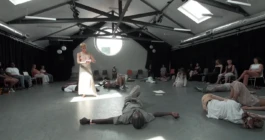
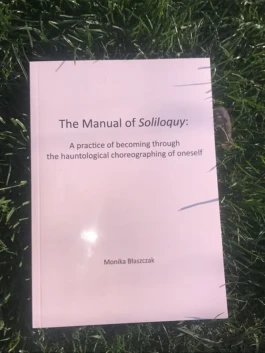
Soliloquy can be experienced through workshops, one-on-one sessions, “The Manual of Soliloquy” (available upon request), and performances that stem from the practice. Performances include the date in the title, e.g., “Soliloquy 16.05.2019.”
As the haunting of the sixth mass extinction grows ever more pressing, Soliloquy asks: what kind of dancing is possible and necessary on a dying planet? How might we activate the transformative power of dance to shift how we relate to the Earth, its ecosystems, and one another? How can we resist the urge to extract, overproduce, and accumulate, and instead engage in processes of love-making, grieving, and creating? These questions are explored from an anticolonial, queer, and feminist perspective, with love as the driving force behind the work.
Soliloquy began as a thesis project at Trinity Laban Conservatoire of Music and Dance in London under guidance from dr Rebecca Stancliffe and was further developed at the Performance Studies Department at New York University Tisch School of the Arts in New York with dr André Lepecki as advisor. It has since expanded through encounters with dancers, workshop participants, researchers, artists, and organic and non-organic bodies.
Soliloquy has been supported or hosted by institutions including University of Chicago (USA), Independent Dance (ENG), Trinity Laban (ENG), Polish Dance Theatre (PL), La Wayaka Current (CL–ENG), Adam Mickiewicz Institute (PL), National Institute of Music and Dance (PL), United-C Eindhoven (NL), V.O Curations (ENG), Glasgow School of Art (SCT), Volksbühne am Rosa-Luxemburg-Platz (DE), among others.
Please reach out if you would like to book a group workshop or one-on-one session, order a digital copy of “The Manual of Soliloquy” or commission a performance.
Soliloquy uses hauntology as a framework for studying the body in its memory and its becoming. The term was coined by Jacques Derrida in “Spectres of Marx: The State of the Debt, the Work of Mourning and the New International” (1993). Derrida’s play on the words “haunted” and “ontology” complicates the classical understanding of time. Grounded in this perspective, Soliloquy is based on the belief that bodies are always-already haunted by personal, collective, and intergenerational histories and desires.
The practice consists of choreographic scores that can be enacted solo or in a group. No prior experience is necessary. The scores invite dancers to explore embodied memory, imagination, and relationality, and to attend to the emotions present in the moment. Through this dance practice, participants metabolize life experience and compose their becoming.
For example, one score invites participants to create a movement gift for a chosen person or entity, for instance the participants’ grandmothers. One by one, dancers step into the center of a circle and offer their movement while others witness, holding space for the gift to be received. The group then echoes and amplifies the gesture, allowing it to resonate collectively before the next person enters. The practice closes with a shared improvisation woven from the traces that have appeared.
Soliloquy can be experienced through workshops, one-on-one sessions, “The Manual of Soliloquy” (available upon request), and performances that stem from the practice. Performances include the date in the title, e.g., “Soliloquy 16.05.2019.”
As the haunting of the sixth mass extinction grows ever more pressing, Soliloquy asks: what kind of dancing is possible and necessary on a dying planet? How might we activate the transformative power of dance to shift how we relate to the Earth, its ecosystems, and one another? How can we resist the urge to extract, overproduce, and accumulate, and instead engage in processes of love-making, grieving, and creating? These questions are explored from an anticolonial, queer, and feminist perspective, with love as the driving force behind the work.
Soliloquy began as a thesis project at Trinity Laban Conservatoire of Music and Dance in London under guidance from dr Rebecca Stancliffe and was further developed at the Performance Studies Department at New York University Tisch School of the Arts in New York with dr André Lepecki as advisor. It has since expanded through encounters with dancers, workshop participants, researchers, artists, and organic and non-organic bodies.
Soliloquy has been supported or hosted by institutions including University of Chicago (USA), Independent Dance (ENG), Trinity Laban (ENG), Polish Dance Theatre (PL), La Wayaka Current (CL–ENG), Adam Mickiewicz Institute (PL), National Institute of Music and Dance (PL), United-C Eindhoven (NL), V.O Curations (ENG), Glasgow School of Art (SCT), Volksbühne am Rosa-Luxemburg-Platz (DE), among others.
Please reach out if you would like to book a group workshop or one-on-one session, order a digital copy of “The Manual of Soliloquy” or commission a performance.